 SimplifyGenAISAGE · September 2026
A team of AI employees that actually shows up.
SAGE (Simplified Autonomous Growth Employees) is a platform for running AI employees inside your company, on a server you own. They remember what you told them last month, do their jobs on a schedule, and message you on WhatsApp when something is done or stuck. You still say yes before anything goes out.
What SAGE is.
SAGE is a way to run AI employees inside your company. Each employee is a program on a server you own, built on Claude Code, Anthropic's agent runtime. It has a job description, a memory that carries over, a schedule, the tools it needs, a chat channel where your team talks to it, and a manager on your side who approves what goes out.
SimplifyGenAI built the platform, runs 25 of these employees, plus 21 bots, for its own companies today, and sets it up for other businesses on their infrastructure.
How it compares with what you already use.
Most companies already pay for a chatbot, an automation tool and an agency or two. This sits in a different place than all three.
| Chatbot subscription | Automation tool | Agency or contractor | SAGE employee | |
|---|---|---|---|---|
| Remembers your context | Only inside one chat | No, it runs fixed steps | Yes, until the person leaves | Yes, in a memory bank you own |
| Does the work, not just answers | No | Simple, predefined steps | Yes | Yes, with real tools |
| Works on a schedule without a prompt | No | Yes | Business hours | Yes, 24 hours a day |
| Handles judgement calls | Yes, when asked | No | Yes | Yes, and escalates the ones it shouldn't make |
| Runs in your cloud | No | Usually not | No | Yes |
| Approval before anything goes out | You copy and paste | Not built in | Depends on the person | Built in, enforced in code |
| Reports to you where you already work | No | Email alerts | Meetings and email | WhatsApp, Telegram, email |
Here's what changes for you.
More pipeline, less chasing
Every morning there's a short list of leads someone has already checked. Outreach is drafted and the mailboxes are warmed up. Grant and partner applications get filled in. SEO fixes go live once one person says yes in the group.
Your week gets quieter
Email is sorted into the CRM within three minutes of landing. You get four short digests a day instead of a status meeting. One recording of you turns into weeks of posts.
You stay in charge
Every run is logged. If something breaks, the watchdog tells you within half an hour. Each employee has a spending cap it can't get around, and it can't message anyone you haven't approved.
Meet the team.
These are the roles running today. Each one is a desk on the floor with its own schedule, its own memory and a manager who says yes.
SEO engine
Reads Search Console, fixes the pages and ships to production after one written go in the group. Cheaper than an agency, and it never forgets a page.
Outbound desk
Finds the right accounts, writes one email per person from a short dossier, warms up the mailboxes and sorts the replies. You send the ones that matter.
Prospector
Posts checked decision-maker leads into your BD group every morning. If fewer than two check out, it holds the batch rather than padding it.
Secretary
Files email into the CRM within three minutes, drafts replies in the thread and keeps the calendar. Drafts come to you, never to the client.
Reporting crew
Morning, midday, end of day and night: a short note on what shipped and what's stuck. Most teams stop holding the status meeting.
Content engine
One recording of your founder becomes daily video posts in their own cloned voice. Someone taps Publish. Nothing posts on its own.
Scout
Grants, accelerators and partner programmes, drafted end to end. It stops the moment a fee, a signature or an interview comes up.
Storefront ops
Converts prices on a live payment rail, reconciles orders, checks uptime and watches search rankings. Running on a real store today.
Concierge
A named employee your customers can message on WhatsApp or Telegram, on the official Business API. We piloted this pattern with a bank.
A day on the floor.
These are real times from the running fleet. In between, the Secretary checks the inbox every three minutes and the Inspector walks the floor every half hour.
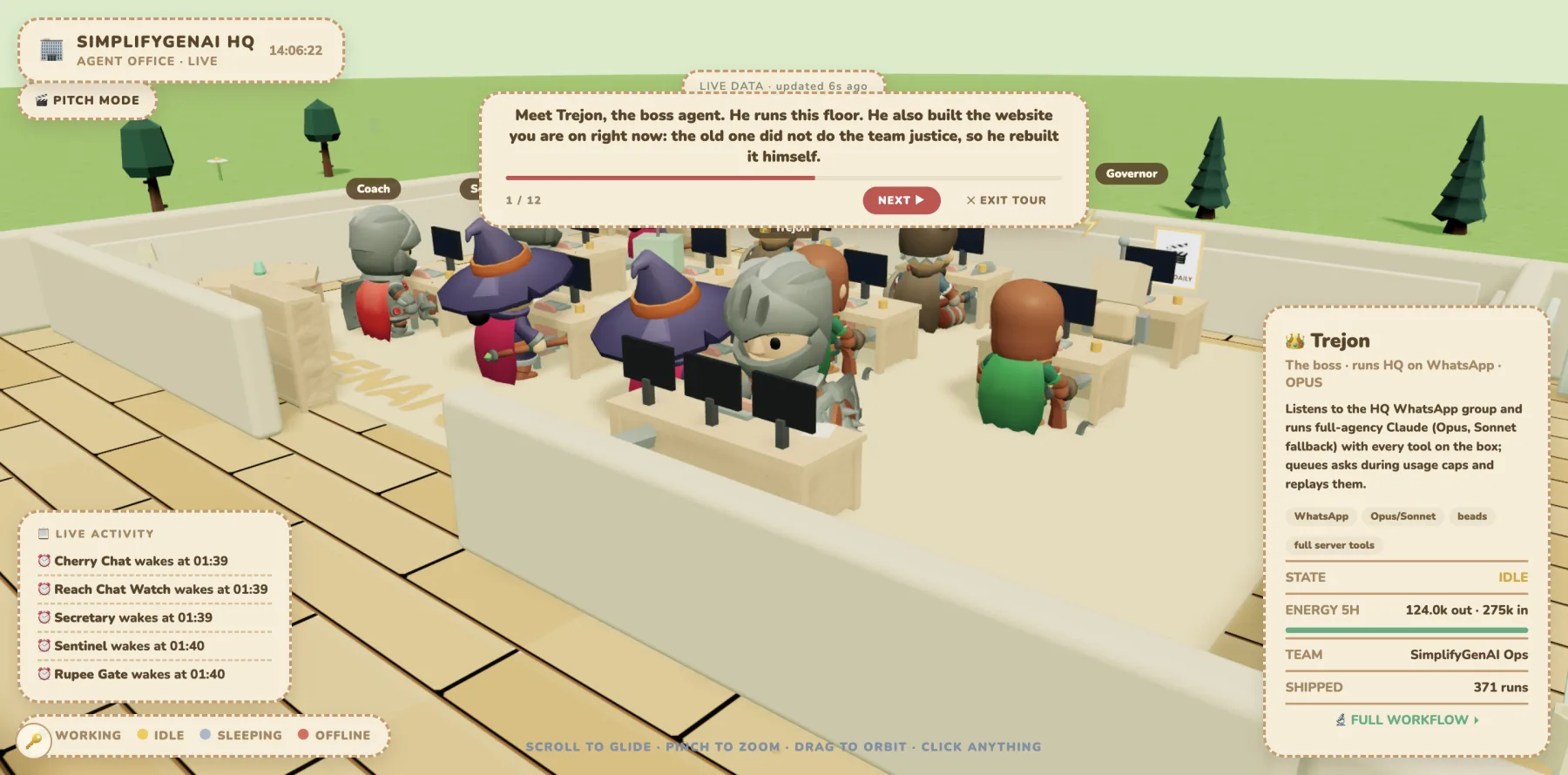
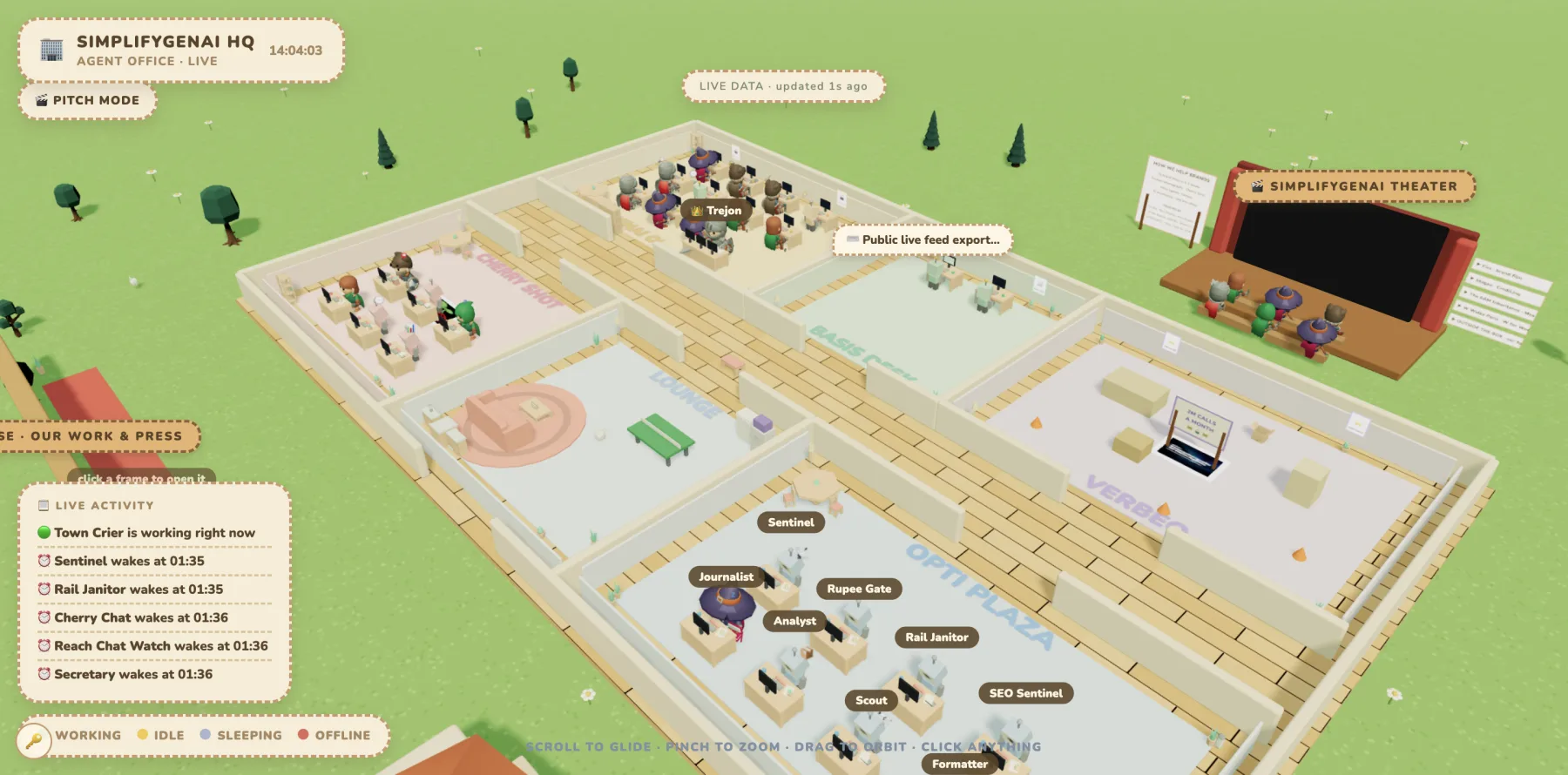
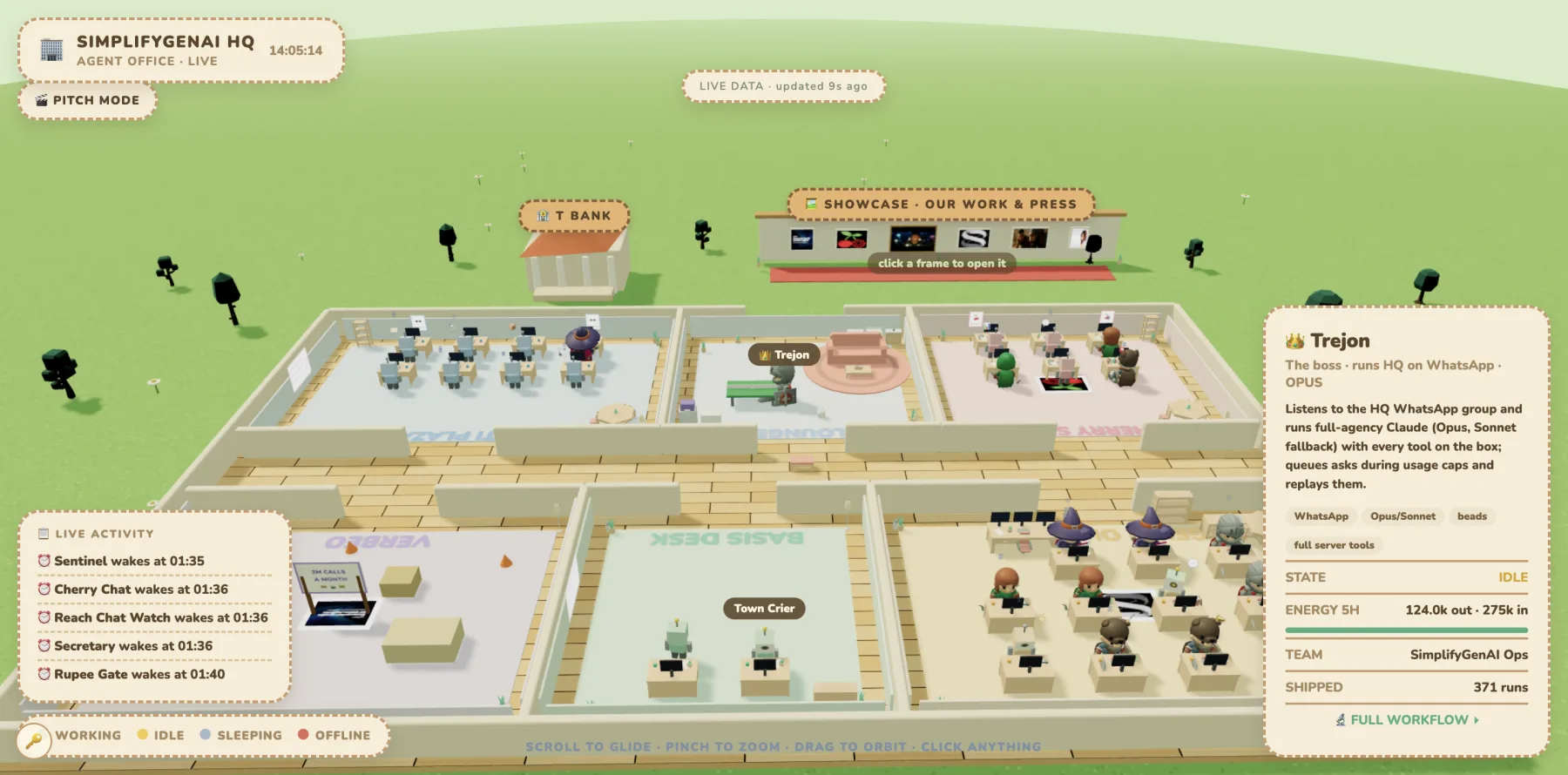
This is the office. Every character is a real process.
Rooms are product lines and characters are employees. Working, sleeping and energy come straight from the server. Click anyone and you see what they're doing and why. Your deployment gets its own floor.
On 26 August it shipped six builds to production by itself.
It read Search Console, wrote the fixes, posted a summary in the WhatsApp group, waited for the marketing owner to write "go", deployed, then loaded the live pages to check its own work. The same run cleared a sitemap problem that had been sitting there for ten months.
Pipeline every morning. A person clicks send.
Fully automated senders get banned and burn the domain, so we didn't build one. The employees do the research, the checking, the drafting and the warm-up. A person sends the email and takes the meeting.
Record once. Post every day.
One three-minute take of your founder. Every new script is voiced in their cloned voice and lip-synced onto that same take, so the face is real. Posting takes about ten minutes a day from a phone.
Message it like a colleague.
Send a voice note or a screenshot to the group. It does the work and replies with what happened and the proof. It won't say "on it" and go quiet.
- WhatsApp for the team, with one group per function and one for HQ.
- Telegram for private coaching and for customer front desks.
- Its own email, calendar and spreadsheets inside your Google Workspace.
An example exchange, written the way the HQ employee actually replies
It remembers what you told it last month.
Saving happens on its own every time a session ends. At 04:30 a curator tidies the memory bank, and a guard stops it from ever deleting something verified. The next session starts with the context already loaded, on whichever machine it runs.
Knowledge
Checked facts, opinions with a confidence score, dated events, one file per contact.
Work
Tasks and blockers in a graph, kept apart from knowledge and synced through git.
Identity
Role, voice and hard rules in plain files you can open and edit.
Someone is always watching.
Inspector
Walks the floor every half hour looking for failed jobs, stuck schedules and low disk or memory. Any crash wakes it straight away. It only speaks when something changes.
Governor
Watches the model subscription. When a cap is hit the whole fleet steps down to lighter models or read-only mode, then recovers on its own.
Budget keeper
Each employee has a daily token budget, set high enough to catch a runaway and not real work. Over budget means the run is skipped before the model is even called.
Breaker ladder
When an employee repeats itself, hits an error storm, stalls or runs over budget, the Inspector steps it down one rung per half hour: a written steer, then a cheaper model and a short run, then a stop. A clean half hour steps it back up.
Nothing goes out without you.
Every employee owes an output.
A job that ran is not a job that delivered. Each employee's entry on the roster says what it owes, in units you can count: leads delivered, articles published, applications submitted, pages shipped. The fleet counts them from the employee's own records once a day. No model is asked whether it did a good job.
2 empty days
Steer
The employee gets a message and has to write down what blocks it, what it needs and what it will change on the next run.
5 empty days
Escalate
Your manager gets a proposal: fix it, change the job, or retire the desk.
7 empty days
Stop
If you switch that on, the unit is stopped until a person releases it.
Night digest, 4 September
Every employee card on the HQ dashboard shows delivered against contracted.
Built as a graph, not one long loop.
Agent systems are now described in five layers: the prompt, the context an agent sees, the harness it runs in, the loop that keeps it going, and the graph that organises many agents. SAGE has a concrete answer at each one.
Work graph
Every task is an issue with typed links: blocks, parent, discovered from, supersedes. An employee starts its day from what is unblocked, not from a to-do list.
Message graph
Employees write to each other through a mailbox with seven message types, one inbox each, reply threads and a hop limit of six before HQ is pulled in. Every delivery is logged. A founder's instruction becomes a lesson that lands in every future run.
Who may carry what
Each roster entry lists which of three risks the employee carries: untrusted input, private data, reach outside. All three together needs a named supervisor or a recorded waiver, and the audit checks it.
What one desk is worth to you.
A rough estimate to talk around, not a quote. Server and model costs for one desk usually come to a few hundred dollars a month.
Hours back per year
1,560across the team, at the share you set
Full-time people freed up
0.8for work that needs a person
What that time costs today
$93,600per year at your hourly rate
Hours back per week
30every week, without overtime or handovers
Six answers and we can name your first employee.
One conversation with whoever owns the process is enough. We turn the answers into a job description, a schedule, a channel and an approval rule.
You bring
- A server or VM in your cloud
- A model subscription seat
- Access to the chat your team uses
- One person who owns the outcome
1
Which process eats the most hours?
Reporting, inbox, research, listings, follow-ups, content. Pick the one people complain about.
2
Who owns it, and who approves the output?
That person becomes the employee's manager. Their written go is the approval.
3
Which tools and data does it touch?
CRM, inbox, storefront, repo, analytics, documents. Read or write, for each one.
4
Where does your team talk?
WhatsApp, Slack, Teams, Telegram, email. The employee joins that room.
5
What must never happen without a person?
Sends, payments, deploys, promises to customers. These become the hard stops.
6
What number should move in 90 days?
Hours saved, leads per week, pages shipped, reply time. We report against it.
How it starts.
You own everything
Identity, memory, schedules and rules are files in your repository. Clone them somewhere else and the employees come along.
Weeks, not quarters
The platform already runs 25 AI employees and 21 bots. A new desk is configuration and a conversation, not a build.
Checked, not trusted
A self-audit script checks the host against the operating rules. The technical brief has the detail.
Questions we get asked.
What if it makes a mistake?
It can, like a new hire. The difference is that nothing goes out without a person, every run is logged, and the watchdog reports a failure within half an hour. A bad draft gets corrected in the same chat.
What does it cost to run?
Your server, a model seat, and our setup and support. Running one desk usually comes to a few hundred dollars a month. We scope the setup per desk once we have the six answers.
Can we use a different model?
Yes. The runtime is not tied to one provider. The fleet runs on Claude today with a cheaper model for lighter work and a free one when a cap is hit.
Where does our data go?
It stays in your cloud. Prompts and results go to the model provider under that provider's terms, the same as any AI tool you already use. Nothing is sent to us.
What happens if we stop?
You keep the repository, the memory and the employees. They are files. Turn off the timers and they stop. Turn them back on and they pick up where they left off.
Who maintains it?
The fleet maintains itself: weekly updates, log cleanup and a self-audit. We handle changes to an employee's job and add new desks with you.
Why not just install an open-source agent framework?
OpenClaw and Hermes Agent are good projects and we've borrowed ideas from both. This is where the two approaches part ways.
Who's behind it.
SimplifyGenAI is an applied AI studio. We build products and run them, and this fleet started as the team that runs our own companies. It has been on the job since mid 2026.
Cherry Shot
An AI product photography app. The SEO engine, the outbound desk and the grant scout in this deck work for it every day.
Verbeo
Voice agents that answer calls for businesses, handling about two million calls a month.
T Bank
A virtual-employee pilot for a bank in Bhutan: a banking simulation staffed by named AI employees in Telegram, with a staff portal.
The fleet itself
46 employees and bots on one small server, running SEO, outbound, storefront operations, reporting and self-maintenance for the companies above.
SimplifyGenAIsimplifygenai.comEvery desk started empty. Yours is next.
Bring the six answers to a 30-minute call. We design the employee with you, set it up in your cloud, and hand you the keys and the repository.